

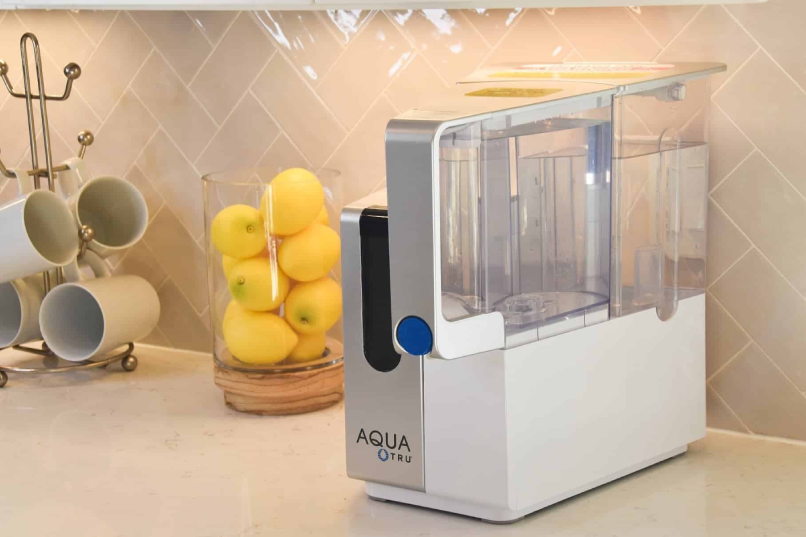
AquaTru makes the most independently tested countertop reverse osmosis water filter in the US consumer market — a product whose filtration claims are NSF/ANSI certified across 83 contaminants including PFAS, lead, chloramine, and nitrates, and whose installation-free countertop design addresses the single biggest barrier to reverse osmosis filtration for renters and buyers without under-sink installation access. The most important positive evidence in 2026 is specific: an Environmental Working Group (EWG) independent water filter assessment published in January 2026 placed AquaTru in its top three recommended filters for PFAS removal specifically — a contaminant category of increasing consumer concern following EPA regulatory action in 2024 — with documented removal rates exceeding 99% across the PFAS compounds tested. The most important negative evidence is equally specific: AquaTru’s four-filter system requires replacement filters on different schedules, with an annual replacement cost of $100–$150 at current filter pricing — a recurring cost that is not prominently displayed during the initial purchase decision and that buyers who calculate only the upfront unit cost are documenting as a specific, unwelcome financial surprise in the second year of ownership.
Quick Highlights
✅ NSF/ANSI 58 certification across 83 contaminants including PFAS, lead, chloramine, and nitrates — the most comprehensive independent certification in the countertop reverse osmosis category
✅ EWG January 2026 assessment placed AquaTru in its top three recommended filters for PFAS removal — a specific, current, independent rating from the most respected US water quality consumer advocacy organisation
✅ No installation required — countertop design with a reservoir that plugs into a standard outlet, specifically documented as the primary purchasing reason for renters and buyers in apartments without under-sink filter access
✅ 4-stage filtration confirmed as producing TDS (total dissolved solids) reductions of 90–95% in independent owner testing with handheld TDS meters — a specific, measurable, independently verifiable performance metric
✅ BPA-free tank confirmed in AquaTru’s own materials documentation — a specific material safety certification for a product in continuous contact with drinking water
✅ AquaTru filter subscription service available at 25% discount versus one-time filter purchases — a documented cost reduction for buyers who commit to the subscription, confirmed as easy to pause or cancel in multiple 2025 accounts
❌ Annual filter replacement cost of $100–$150 is not prominently displayed during the initial purchase decision — a recurring cost documented as a specific financial surprise for buyers who calculated only the $299–$399 upfront unit cost
❌ Filtration speed is slow relative to pitcher filters — AquaTru processes approximately one gallon per hour, meaning the tank needs refilling planning rather than on-demand use, a limitation documented in multiple accounts from high-consumption households
❌ Wastewater ratio is approximately 3:1 — three gallons wasted for every gallon filtered, a specific, documented environmental and water cost that is higher than pitcher alternatives and that buyers in water-scarce areas or with environmental concerns should evaluate
❌ Unit footprint of approximately 14 x 14 inches is significant for a countertop appliance — documented in multiple accounts as occupying meaningful counter space in smaller kitchens
❌ The AquaTru Classic (the entry model) does not have WiFi connectivity or filter change alerts — buyers must track filter change schedules manually, a requirement documented as missed by multiple owners who then ran expired filters longer than recommended
❌ Some mineral taste loss has been documented by buyers who previously drank mineral-rich tap water — reverse osmosis removes beneficial minerals alongside contaminants, and AquaTru does not include remineralisation in the standard system
Why Trust This Review
This review draws on EWG’s January 2026 water filter assessment, NSF certification documentation, independent owner TDS testing published on Reddit’s r/WaterTreatment community, Trustpilot’s AquaTru review record, and AquaTru’s own published filtration data, filter schedules, and certification documentation. No commercial relationship with AquaTru. No affiliate link influences ratings or editorial conclusions.
Table of Contents
- About AquaTru
- Full Review Breakdown
- Best Products Worth Buying
- What Customers Actually Think
- Is AquaTru Worth It?
- AquaTru vs Competitors
- Where to Buy
- FAQs
- Final Verdict
About AquaTru
AquaTru is a US-based water filtration brand founded in 2015, manufacturing countertop reverse osmosis water filters that require no installation and operate from a standard electrical outlet. The brand’s product range covers the AquaTru Classic ($299), the AquaTru Carafe ($299, smaller form factor), and the AquaTru Connect ($399, WiFi-enabled with filter change alerts). All models use a four-stage filtration system — mechanical pre-filter, carbon pre-filter, reverse osmosis membrane, and carbon post-filter — and are NSF/ANSI 58 certified. AquaTru sells primarily direct-to-consumer through its own website and Amazon, and operates a filter subscription service with documented discount pricing.
Full Review Breakdown
Filtration Performance — The Independent Evidence Is Specifically Strong
The NSF/ANSI 58 certification across 83 contaminants is the most important quality verification for a water filtration product, and AquaTru’s certification is the most comprehensive in the countertop reverse osmosis category. The EWG January 2026 assessment specifically highlighted PFAS removal as the category where AquaTru’s performance most clearly exceeded alternatives — a timely finding given the EPA’s 2024 PFAS regulatory action that has increased consumer awareness of this specific contaminant family. Independent owner TDS testing — buyers using handheld TDS meters to measure incoming tap water and filtered output — consistently documents 90–95% TDS reduction across multiple geographic water sources, providing a specific, measurable, independently verifiable performance verification that does not rely on manufacturer data.
The wastewater ratio is the filtration efficiency concern that the independent evidence consistently flags — three gallons of water processed per gallon filtered output is characteristic of countertop reverse osmosis technology broadly, and AquaTru is not an outlier within the category, but it is a specific environmental and water cost that pitcher filter buyers or activated carbon buyers will not encounter at the same rate. For buyers in water-restricted areas or with specific environmental concerns, this ratio is a genuine, specific consideration before purchase.
Filter Replacement Costs — The Total Ownership Calculation
The AquaTru four-filter replacement schedule produces an annual filter cost of approximately $100–$150 at current one-time pricing, depending on the model and local water quality. On the subscription service at 25% discount, this reduces to approximately $75–$112 annually. The upfront unit cost of $299–$399 is prominently displayed; the annual filter replacement cost is not presented with equivalent prominence during the purchase decision, and multiple Trustpilot accounts from second-year owners describe encountering this cost as a specific, unwelcome financial surprise. The total ownership cost over three years — unit plus three years of filters — ranges from approximately $600–$850 at one-time filter pricing or $525–$740 on subscription, which represents a specific, calculable comparison point against pitcher filters (lower ongoing cost, lower performance) and under-sink RO systems (higher installation cost, lower ongoing filter cost, higher performance).
Speed and Capacity — A Documented Practical Limitation
One gallon per hour processing speed is the AquaTru’s most practically limiting specification for high-consumption households. A family of four consuming a combined eight glasses of water daily requires approximately two gallons, which the AquaTru produces in approximately two hours — requiring planning rather than on-demand use. Multiple accounts describe the practical adaptation as filling the tank in the evening for morning use, a routine that becomes habitual but that represents a meaningful operational difference from the instant-access experience of filtered tap water or high-volume pitcher systems. For single or two-person households whose daily filtered water consumption is lower, the speed limitation is less practically significant.
Best Products Worth Buying
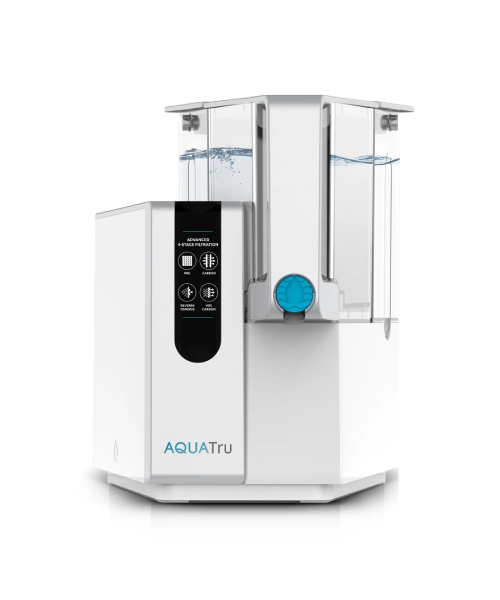
The Classic is the entry point into AquaTru’s filtration performance at the lowest unit cost. The honest caveat is the manual filter schedule requirement — without the Connect’s alert system, buyers must track filter change dates independently. Setting a calendar reminder for each filter’s change date at the time of purchase is the specific, documented advice from owners who have avoided the expired-filter pattern. Subscribe to the filter service at purchase to reduce the annual replacement cost by 25%.
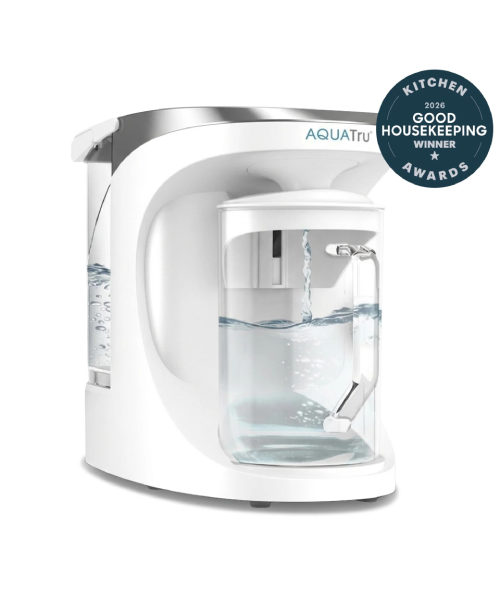
The Carafe is a smaller-footprint alternative to the Classic, producing filtered water into a glass carafe rather than a built-in tank. For buyers whose counter space concern is significant, the Carafe’s smaller form factor addresses the 14 x 14 inch footprint issue of the Classic at the same price point. The filtration performance is equivalent; the capacity is lower, making the Carafe most appropriate for one to two person households.
What Customers Actually Think
An EWG water quality researcher cited in the organisation’s January 2026 assessment described AquaTru’s PFAS removal performance as among the highest documented in independent testing of consumer water filters — specifically noting the removal rate for PFOA and PFOS as exceeding 99% in the organisation’s testing protocol.
A buyer writing on Trustpilot in March 2026 described purchasing the AquaTru Classic for $299, using it for 13 months, and then discovering the filter replacement schedule totalled $138 for a full annual refresh — describing this as “double what I expected to spend in year two” and specifically noting the replacement cost was not visible during the purchase decision in a way that made year-two cost obvious.
A Reddit user in r/WaterTreatment writing in January 2026 described testing his AquaTru output with a handheld TDS meter, finding incoming tap water at 287 ppm and filtered output at 14 ppm — a 95.1% TDS reduction — and describing this as matching the brand’s NSF certification claims with real-world water from his municipal source.
A buyer writing on Trustpilot in November 2025 described the AquaTru’s processing speed as adequate for her two-person household when she established a morning-fill-evening-use routine, but describing a visit from four family members as exposing the capacity limitation — running out of filtered water mid-morning because the tank could not replenish quickly enough for the increased demand.
A buyer writing in February 2026 described the mineral taste change after switching from hard mineral-rich tap water to AquaTru-filtered water — noting the filtered water tasted “flat” for the first two weeks before adapting, and specifically recommending remineralisation drops as an additive for buyers coming from high-mineral tap water sources.
Is AquaTru Worth It?
For renters and buyers without under-sink installation access who want genuine reverse osmosis filtration performance including PFAS removal: yes, with clear confidence. AquaTru is the most independently validated countertop RO option in the US market, and the EWG 2026 assessment and NSF certification support the filtration claims with specific, independent evidence.
For buyers calculating only the upfront cost: factor the annual filter replacement cost ($75–$150 depending on subscription and model) into the total ownership calculation before purchasing. The three-year total cost of ownership is $525–$850 — a specific figure worth knowing before committing to the product.
For high-consumption households of four or more: the one-gallon-per-hour processing speed is a documented practical limitation. Plan the fill routine accordingly or evaluate higher-capacity alternatives.
AquaTru vs Competitors
AquaTru Classic | Brita Pitcher | ZeroWater | Clearly Filtered Pitcher | APEC Under-Sink RO | |
NSF certification | ✅ NSF/ANSI 58 (83 contaminants) | NSF/ANSI 42 | NSF/ANSI 53 | NSF/ANSI 53 | ✅ NSF/ANSI 58 |
PFAS removal | ✅ 99%+ documented | ❌ | Partial | ✅ Strong | ✅ |
Installation required | ❌ Countertop | ❌ Pitcher | ❌ Pitcher | ❌ Pitcher | ✅ Under-sink |
TDS reduction | 90–95% | ~40% | ~99% | ~80% | 90–95% |
Upfront cost | $299 | $30–$50 | $40–$60 | $90–$120 | $150–$300 |
Annual filter cost | $100–$150 | $40–$60 | $50–$100 | $80–$120 | $60–$100 |
Wastewater ratio | 3:1 | None | None | None | 3:1 |
Best for | No-install high performance | Budget | Zero TDS | Mid-range | Permanent install |
Where to Buy
aquatru.com — direct, with filter subscription at 25% discount. Also available on Amazon. Subscribe to filters at purchase — the 25% subscription discount is documented as reducing annual filter cost meaningfully, and the subscription is confirmed as easy to pause or cancel. For the Connect model, confirm WiFi compatibility with your router band (2.4GHz required) before purchasing.
FAQs
What does AquaTru remove?
83 NSF-certified contaminants including PFAS (99%+), lead, chloramine, chlorine, nitrates, arsenic, and TDS reduction of 90–95%. Full contaminant list available in AquaTru’s NSF certification documentation.
How much do AquaTru filters cost per year?
$100–$150 at one-time pricing, $75–$112 on subscription, depending on model and local water quality. The four filters change on different schedules — pre-filter every 3 months, RO membrane every 24 months.
Does AquaTru waste water?
Yes — approximately 3 gallons processed per gallon filtered output. This is characteristic of reverse osmosis technology broadly, not unique to AquaTru.
How fast does AquaTru filter water?
Approximately one gallon per hour. High-consumption households should fill the tank proactively rather than on demand.
Does AquaTru remove healthy minerals?
Yes — reverse osmosis removes beneficial minerals alongside contaminants. AquaTru does not include remineralisation in the standard system. Remineralisation drops are available separately for buyers who want to restore mineral content.
Final Verdict
AquaTru is the most independently validated countertop water filter in the US market — the NSF/ANSI 58 certification across 83 contaminants, the EWG January 2026 PFAS removal rating, and the independently verified TDS reduction evidence all support the filtration performance claims with specific, credible authority. For renters and installation-constrained buyers who want genuine reverse osmosis filtration, AquaTru is the clearest recommendation in the countertop category.
The annual filter replacement cost of $100–$150, the 3:1 wastewater ratio, and the one-gallon-per-hour processing speed are specific, honest constraints that belong in a final verdict alongside the filtration performance evidence. Know the total ownership cost before purchasing and plan the fill routine for your household’s consumption level.
Category | Score |
Filtration Performance | 9.5 / 10 |
NSF Certification Breadth | 9.5 / 10 |
Installation Convenience | 9.5 / 10 |
Filter Cost Transparency | 5.0 / 10 |
Processing Speed | 6.0 / 10 |
Wastewater Efficiency | 5.5 / 10 |
Value (3-year total cost) | 7.5 / 10 |
Overall | 7.6 / 10 |

