
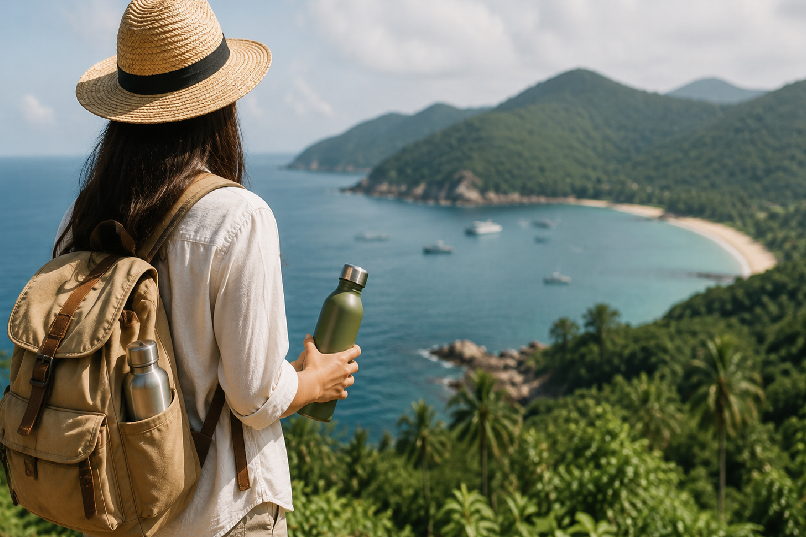
Sustainable travel is the category most dominated by aspiration rather than impact — the reusable straw in the hotel that was flown to on a fuel-heavy long-haul flight. The carbon offset purchased as a moral salve rather than a meaningful intervention. The “eco-friendly resort” designation that means recycling bins in the room and doesn’t extend to where the food was sourced or how the staff were paid.
Honest sustainable travel acknowledges that flying has a carbon impact that is genuinely difficult to offset and genuinely difficult to avoid if international travel is the aspiration. The traveller who wants to make more sustainable travel choices needs to acknowledge this starting point rather than managing around it through small choices that don’t address the major impact.
The Honest Sustainable Travel Framework
Flight frequency is the most significant variable. One long-haul flight per year produces more aviation carbon than all other travel sustainability choices combined. The traveller who flies once per year and makes excellent choices in every other aspect of travel has a significantly lower travel carbon impact than the traveller who flies six times per year and makes excellent sustainable choices on every trip.
Train over plane where practical. The specific sustainable travel choice with the most direct impact reduction available to most travellers: taking the train for journeys where the time investment is manageable. London to Paris (2h15m by Eurostar) is a no-compromise switch from flying — faster city centre to city centre, lower emissions. London to Edinburgh (4.5h by train) is close. London to Milan (approximately 9h, with a sleeper option) — the sustainable choice requires an overnight.
Stay longer, go less often. The carbon impact per day of a two-week trip is half the impact per day of a one-week trip to the same destination on the same flight. The trip that covers more ground in one longer visit is more sustainable than two shorter visits to the same region.
The Best Eco-Friendly Travel Products And Practices
Reusable Water Bottle — Eliminating Plastic Water Purchases
Available at: Hydro Flask (hydroflask.com), S’well (swellbottle.com), any outdoor retailer
Best for: Eliminating the daily plastic water bottle purchase that produces a significant volume of single-use plastic during travel.

The reusable water bottle is the travel sustainability product with the most direct, most daily impact — the specific replacement of one to three plastic water bottle purchases per travel day with a single refillable alternative. Over a two-week trip, the elimination of 14–40 plastic bottles is the specific impact that accumulates meaningfully when multiplied across all travel days.
The Hydro Flask 40oz or S’well 34oz are the specific recommendations — large enough to reduce refilling frequency, insulated to maintain cold temperature across a day’s sightseeing, and durable enough to survive the travel bag impacts that standard bottles don’t.
Bamboo Cutlery Set — For Street Food And Picnic Eating
Available at: Amazon, zero-waste retailers
Best for: Eliminating single-use plastic cutlery from street food and takeaway eating during travel.
The bamboo cutlery set — fork, knife, spoon, chopsticks, and straw in a small roll-up case — eliminates the specific single-use plastic cutlery that street food and takeaway eating generates in most destinations. At less than 100 grams, it adds no meaningful weight to a travel bag and produces the specific daily plastic elimination that the frequency of street food eating makes significant.
Solid Toiletries — For Plastic-Free Personal Care
Available at: Lush (lush.com), Ethique (ethique.com), various zero-waste retailers
Best for: Eliminating the plastic bottles that liquid toiletries require and reducing liquid volume for carry-on packing.
Solid shampoo, conditioner, body wash, and face wash bars eliminate the plastic bottles that liquid toiletries require — the specific packaging waste that travel generates at a higher rate than daily life because single-use travel sizes are the convenience option most travellers reach for. The solid bar format is also carry-on compliant without the 100ml liquid restriction — the specific travel convenience that liquid-to-solid switching provides alongside the sustainability benefit.
Lush’s solid shampoo bars and Ethique’s range are the recommendations — genuinely effective products that produce the same cleanliness result as their liquid equivalents in a format that doesn’t require plastic packaging.
Sustainable Train Travel — The Low-Carbon Alternative
Available at: Trainline (thetrainline.com), Eurail (eurail.com)
Best for: Travel within Europe where rail is a genuinely competitive alternative to short-haul flying.
The Eurail Global Pass provides unlimited train travel across 33 European countries for a fixed price — the specific product that makes train-based multi-country European travel financially comparable to short-haul flights when the full cost comparison includes transport to distant airports, checked luggage fees, and airport time.
The overnight train option — the sleeper train that covers distance while also providing accommodation — is the specific sustainable travel format that produces the best comparison to the equivalent short-haul flight: the sleeper train from Paris to Barcelona takes approximately nine hours, includes a bed, and arrives refreshed rather than at midnight from a budget airline.
Responsible Travel — For Ethical Tour Booking
Available at: Responsible Travel (responsibletravel.com)
Best for: Those who want to book tours and experiences that are certified for their ethical and environmental standards.

Responsible Travel is the tour booking platform that specifically curates tours based on their environmental and social responsibility standards — the specific alternative to the large tour operators whose environmental and social impact is less curated. The tours include wildlife experiences that prioritise welfare, community tourism that distributes income to local communities, and adventure travel that uses local guides and locally owned accommodation.
Conclusion
Sustainable travel produces genuinely lower impact when the major decisions — how often to fly, whether to take the train, how long to stay — are made deliberately rather than when the focus is entirely on the small choices that don’t address the primary impact. Reduce flight frequency where the aspiration allows. Take trains where the time is manageable and the route is served. Stay longer on each trip. Use reusable water bottles, solid toiletries, and bamboo cutlery to eliminate the daily single-use plastic that accumulates over travel days. And book through Responsible Travel when organised tours are part of the trip. These specific choices, in order of their impact, produce the most honest sustainable travel practice available.

